

Who Made The Call?
Trust is not a feeling. It is an infrastructure.
The thesis
Why do projects fail when the experts are in the room? Because responsibility migrates to those who cannot refuse it. A framework — Attention, Value, Trust — to diagnose and correct the drift.
Adilea Publishing · ISBN 978-2-9604274-0-0 · Original French edition, Brussels
Provisional English translation — the author will supply the validated final text.
One afternoon in Los Angeles, an Iranian salesman picks up the phone to call a seamstress. The problem moves from my side to his. Three seconds. No contract, no governance. Just a choice.
What you will recognize in this book is why that choice works between two people but collapses at ten thousand. And what you can change about it starting tomorrow.
Trust is not a feeling. It is an infrastructure.
Across twenty-nine chapters and four true stories — a public tender, an IT modernization, a European platform, a network operator in crisis — Jean-Paul Delmeire and Peter Janssens offer a single framework (Attention, Value, Trust) to transform organizations where responsibility migrates, pressure rises, and no one knows who is accountable anymore.
No recipe. No five-step model. A diagnosis. And the mechanisms to fix it.
For whom
For executives, consultants, project leaders and professionals who recognize the pattern: projects fail with experts in the room, escalation feels like an ambush, and no one knows who is accountable.
The AVT framework
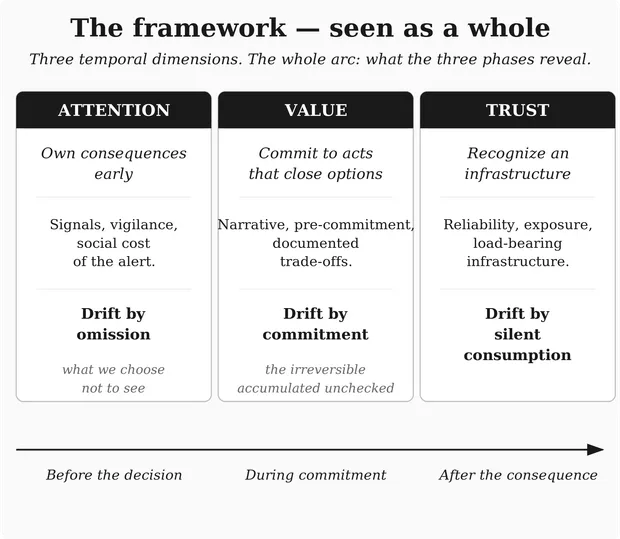
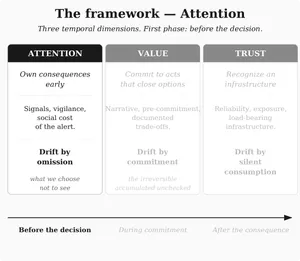
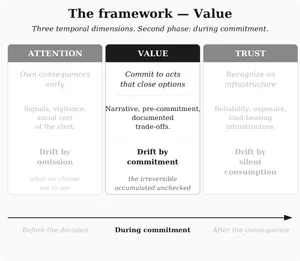
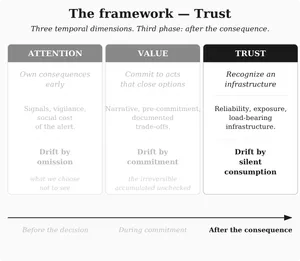
Attention, Value, Trust: the three dimensions where uncertainty lands in an organization. Attention is what you do before delivery. Value is what holds after. Trust is the infrastructure that lets both work without bleeding the people closest to the work.
Four true stories
The public tender
A small firm bids for a public contract it was not supposed to win — and discovers what early attention changes about the outcome.
The IT modernization
A large organization launches an IT transformation that derails, while governance, on paper, keeps working.
The European platform
A public institution builds shared infrastructure under political pressure — where value is proven through irreversible acts.
The network operator
A critical-infrastructure operator learned from its accidents: what trust costs once it has already been consumed.
Excerpt — Introduction
Provisional English translation — the author will supply the validated final text.
My hand is still on the door handle when the verdict lands. "Sorry sir, we don't have your size." The salesman hasn't moved from behind his counter. Didn't check a rack, didn't ask a question. One glance at my frame was enough.
That day I make a silent decision: I will never set foot in that brand again. When trust collapses cleanly, avoidance becomes automatic.
Twenty years later, Los Angeles. I walk into a store of the same brand. The man who approaches me does none of what I expect. He walks toward me like someone who has decided to start a conversation. "I'm Reza. I'm Iranian." His first question isn't about my size or my budget. "What do you do for a living?"
When a problem appears — the alterations won't be ready before our flight — Reza doesn't look for an excuse. He stops. Not a hesitation, a decision. The problem moves from my side of the table to his. He didn't solve the problem for me. He absorbed it for me.
Between two people, trust can work. It only takes one person deciding the cost of error will be theirs. But Reza was one person. In an organization, no one does what Reza did alone. Uncertainty arrives, and everyone passes it around: managers defer it, procedures disguise it as compliance, org charts redirect it. In the end someone carries it anyway — but rarely the person who chose it.
This movement is called responsibility drift. In organizations, responsibility obeys gravity: it flows downward, toward whoever cannot refuse it. Not because anyone decided it, but because no one prevented it. If this book has one message, it is this: don't let gravity decide for you.
Table of contents
Opening
- Authors' preface
- How to read this book
- Introduction
I. Attention — taking on consequences early
- 1. When the problem arrives before we look
- 2. When attention is tested early
- 3. The resignation no one saw coming
- 4. When "it's a comfort thing" closes the conversation
- 5. The false agreement as a failure of attention
- 6. When winning reduces attention
- 7. The contract we sign without reading
- 8. When documenting replaces solving
II. Value — committing to irreversible acts
- 9. Value begins where reversibility ends
- 10. When innovation slips off the radar
- 11. Narrative as a vehicle for value
- 12. Proactivity, or intervention
- 13. Responsibility under uncertainty
- 14. Value claims are always relative
- 15. Know how your industry assigns responsibility
- 16. Why delivering value is not enough
III. Trust — recognizing an infrastructure
- 17. When the problem arrives, trust was already there
- 18. Reliability without guarantees
- 19. Influence without ownership
- 20. When integrity is no longer enough
- 21. Trust in action
- 22. The AVT framework — what the three phases reveal together
IV. The architecture in daily practice
- 23. Four dimensions for a single decision
- 24. When the system works exactly as designed
- 25. When trust has already been consumed
- 26. Trust architecture by context
- 27. The tools of exposure
- 28. When the audit becomes a conversation
- 29. What the framework can, and cannot, do
Closing
- Conclusion
- Appendices — diagnostic checklist, glossary, decision journal
- Bibliography (57 sources)
Drawing on 57 academic sources — Luhmann, Edmondson, March, Perrow, Hood, Weick, Reason — and grounded in its authors' operational experience.
And your organization?
Take the AVT diagnostic in five minutes: where attention, value and trust are built — or lost.
Take the diagnosticAdditional material
Resources, appendices and complementary tools will be added here after launch.
The authors

Jean-Paul Delmeire is a consultant in organizational transformation, specializing in critical systems and the governance of complex projects. For twenty years he has worked with public and private organizations where technical competence gives way to the architecture of responsibility. He is COO/CTO of WeLink.Care.
Peter Janssens, trained in psychology, has led complex programmes (CRM, ERP, cloud, data) in multinational environments (Proximus NXT, Avanade, Accenture, Atos). His dual background gave him a particular eye for what holds — or breaks — trust in organizations.